

Smart Client Security
Many of our Clients’ custom applications involve management of highly sensitive,
proprietary business data e.g. financial records, patient records, legal contracts,
transaction data, etc. The Smart Client platform is built to enable a trusted Client-Server
connection over the Internet, and can be readily configured to support
the most rigorous data security requirements.
Secure data storage, fully-encrypted data transfer payload, and privileged-based access to
the application at the feature-, data-, and reporting-levels are essential considerations for securing
proprietary business data and meeting your internal and external security requirements.
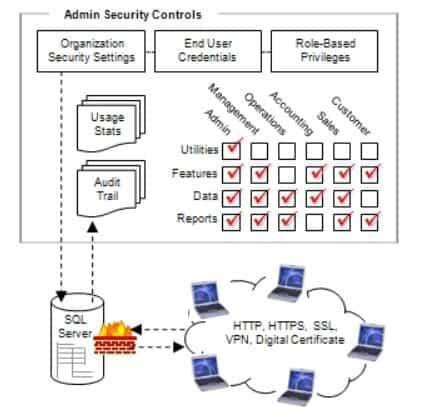
For example, the Smart Client architecture (based upon Microsoft SQL Server and the .NET
Framework) supports HIPAA standards for electronic information storage, encryption,
transfer and processing of patient-sensitive healthcare and patient data.
Role-based User Privileges
All Smart Client applications use a standard, Admin-managed role-based security
framework for determining who gets access to what, at the application feature-, data-, and reporting-levels.
Security settings are stored in the SQL Server database, and Administrators can readily assign
and manage different application use-privileges to different roles within and/or
outside the organization. Admin changes to privilege settings are automatically inherited by
all Users who are members of a particular role.
Secure Data Transport Layer
Smart Client applications connect to a SQL Server database through the standard
Ports 80 and 443. Port 443 is used with secure encrypted SSL for data where high
security compliance is mandated. All data packets transmitted between the database
and the application are compressed into binary format, hence unintelligible to any
intrusion attempt that may inadvertently (or purposefully) be exposed to one
or more data packets. Smart Client applications function and perform very well in
standard HTTP, HTTPS, SSL, VPN and Digital Certificate environments.
SQL Server Storage and Encryption
Server-based database security and management is a core consideration within secure
business application environments. MS SQL Server fully complies with technical requirements
for server-side data storage. Individual Database data elements can be stored, tracked
and secured and audited in any variety of methods supported by SQL Server.
Session-based User Data Storage
Once application data is delivered from SQL
Server through a secure transfer process, the Smart Client application architecture provides considerable power and flexibility
for protecting data on a Users’ local PC. Specific data is received from
the SQL Server for various user-related needs; data input, refinement, and reporting
for example. During a session, a secure connection is maintained between the Server
and Client application, and application
data only exists on the User's PC during the active session. Once a User logs-out (or after a pre-determined time of
inactivity), all the application data can be removed from the User's PC. Smart Clients can be configured so that NO DATA RESIDES ON THE CLIENT PC.
Usage Monitoring & Audit Trail
PCA Smart Client applications also provide for ongoing monitoring, tracking and
reporting of application usage. Administrators know precisely WHO, WHEN and HOW
OFTEN every authorized user accesses a Smart Client application. PCA Smart Clients
provide administrators with a full 360-degree view over and control and monitoring
of application security. A complete Audit Trail is a standard capability of Smart Client applications.